

- Published on
Marubozu Candlestick Pattern: Meaning, Types & Strategies

- Name
- Tails Azimuth

Master the Marubozu Candlestick Pattern for Better Trading Decisions
What if you could predict market momentum with just a single glance at your chart? The Marubozu pattern makes that possible.
The Marubozu candlestick pattern is a go-to tool for traders who want to spot strong market trends quickly. It helps you see when buyers or sellers are in total control of the market. This makes it a must-know pattern for anyone looking to improve their trading strategy.
By the end of this article, you'll learn how to spot bullish and bearish Marubozu candlesticks and use them in your trading strategy. This will help you follow trends with more confidence and lower your trading risks.
What Is a Marubozu Candle?
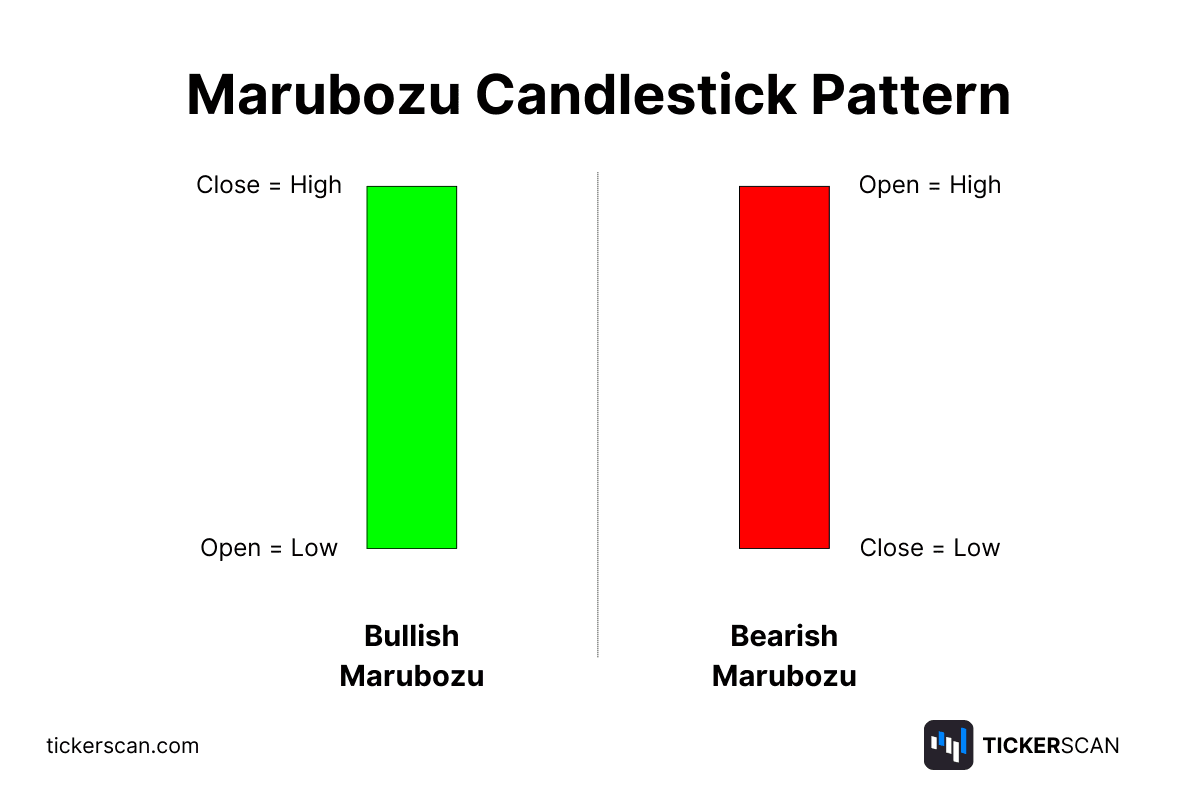
A Marubozu candle is a type of single candlestick pattern that shows strong market momentum in a single direction. What makes the Marubozu unique is that it has no wicks or shadows. This means the price opened at one extreme (either the high or low) and closed at the opposite extreme.
When you see a Marubozu candle, it tells you that either buyers or sellers were fully in control throughout the trading session. There was no hesitation in the market—just clear movement in one direction.
Historical Context of the Marubozu Candlestick Pattern
The Marubozu candlestick pattern has a long history. It was first used by Japanese rice traders in the 1700s. One of the best-known traders of that time, Munehisa Homma, is credited with creating candlestick charts. Homma’s charts, including the Marubozu, helped traders understand price movements.
Why the Marubozu Was Important to Early Traders
In the past, traders didn’t have advanced tools like we do today. They had to rely on simple patterns to understand the market. The Marubozu pattern was useful because it showed who was in control—the buyers or the sellers.
A Marubozu candle with no wicks made it clear: if the price opened and closed at opposite extremes, either buyers or sellers were completely in charge of that trading session. This gave traders a quick way to predict what might happen next in the market. They used this to make smart trading decisions without needing complex tools.
How the Marubozu Pattern Shapes Modern Trading
Even with today’s technology, traders still use the Marubozu pattern. It’s simple but powerful. The pattern shows strong momentum, telling traders when the market is moving strongly in one direction.
The Marubozu is used in many markets today, from stocks to commodities. While modern trading is much faster, the Marubozu remains one of the easiest ways to see market strength at a glance.
Types of Marubozu Candlestick Patterns
There are several variations of the Marubozu candlestick pattern. Each type gives different insights into the market's strength and direction. Let’s break them down into the most common types.
Bullish Marubozu Candlestick Pattern
A bullish Marubozu candle forms when the price opens at the low of the session and closes at the high. There are no wicks, which means the buyers had complete control throughout the entire trading session. This pattern often signals that prices are likely to continue rising.
What it means: Strong buying pressure, with no resistance from sellers. It often signals the continuation of an uptrend or the start of a bullish reversal.
Bearish Marubozu Candlestick Pattern
A bearish Marubozu candle forms when the price opens at the high and closes at the low, with no wicks. This shows that sellers were in full control, pushing the price down from the start of the session to the end. This pattern often suggests that prices may continue to drop.
What it means: Strong selling pressure, with no pushback from buyers. It’s a sign that the downtrend may continue or that a bearish reversal is starting.
Opening Marubozu Candle
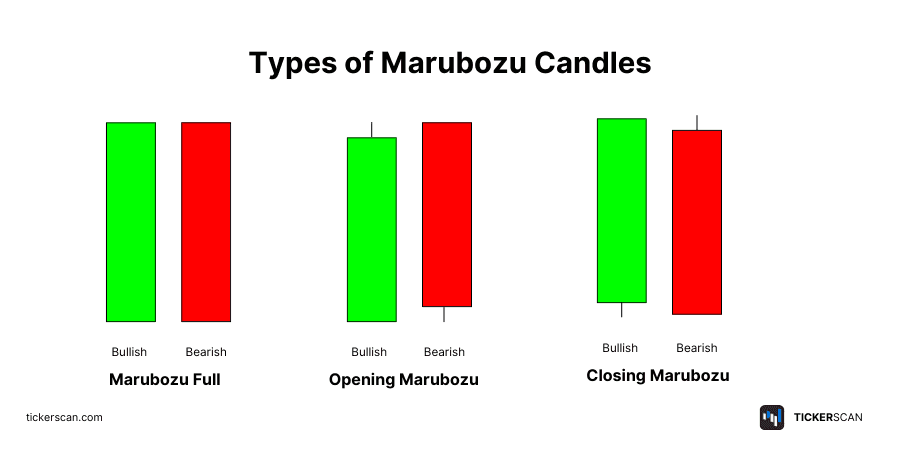
An Opening Marubozu candle occurs when there is no shadow (or wick) on the open side of the candle, but there is a wick on the closing side. This means the market started with strong momentum in one direction, but there was some resistance later in the session.
- Bullish Opening Marubozu: The price opens at the low and moves upward, but sellers cause the price to drop slightly before closing.
- Bearish Opening Marubozu: The price opens at the high, drops, but buyers push it back up slightly before the session closes.
What it means: The market started with strong direction, but some hesitation occurred before closing.
Closing Marubozu Candle
A Closing Marubozu candle is the opposite of the opening Marubozu. In this pattern, there is a shadow on the open side of the candle but not on the closing side. This shows that the market faced some resistance at the start, but by the end of the session, the momentum was strong and decisive.
- Bullish Closing Marubozu: The price opens higher but drops at first, then buyers push it back up, and it closes at the high.
- Bearish Closing Marubozu: The price opens lower but rises at first, then sellers push it down, and it closes at the low.
What it means: The market had some indecision at the start, but by the end of the session, the dominant side (buyers or sellers) took control.
Features of the Marubozu Candlestick Pattern
The Marubozu candlestick pattern is unique and easy to recognize due to its clear structure. Here are the main features that set it apart from other candlestick patterns:
No Wicks or Shadows: The most defining feature of a Marubozu candle is the lack of wicks (or shadows) on either side. This means that the open and close prices are at the extremes of the trading session. The absence of wicks shows that the market moved strongly in one direction without any pullback.
- Bullish Marubozu: Opens at the low, closes at the high.
- Bearish Marubozu: Opens at the high, closes at the low.
Strong Market Control: A Marubozu candle indicates that either buyers or sellers had complete control of the market during that session. In a bullish Marubozu, buyers pushed the price up without any resistance. In a bearish Marubozu, sellers drove the price down without interference from buyers.
Clear Momentum Indicator: The Marubozu candle clearly shows strong momentum in the market. Since the price moved in one direction from the start to the end of the session, it signals that there is strong buying or selling pressure.
- Bullish Marubozu: Momentum is with the buyers.
- Bearish Marubozu: Momentum is with the sellers.
Trend Continuation or Reversal Signal: The Marubozu pattern can signal either a continuation of a trend or the start of a reversal. It depends on where it appears in the chart:
- In a trend: If a Marubozu appears during a trend, it often confirms that the trend will continue. A bullish Marubozu in an uptrend suggests more upward movement, while a bearish Marubozu in a downtrend points to further decline.
- At key levels: If the Marubozu forms at a support or resistance level, it could indicate a reversal. For example, a bullish Marubozu at support might signal the start of a new uptrend.
High Volume Confirms the Pattern: When the Marubozu pattern forms with high trading volume, it’s an even stronger signal. High volume shows that there is more market interest in the move, making the pattern more reliable.
Versatility Across Markets: The Marubozu pattern works across different markets, including stocks, forex, and commodities. Its simplicity makes it a popular tool among traders who want a quick way to assess market strength.
Psychology of the Marubozu Candlestick
When a Marubozu forms, it shows that either buyers or sellers were completely dominant throughout the entire session, without any hesitation or resistance from the opposing side. Here’s what that tells us:
Bullish Marubozu: This pattern indicates that buyers are in full control. From the moment the market opened, buyers pushed the price higher, and sellers were unable to stop them. The absence of any wicks shows that there was no resistance from sellers, signaling strong confidence and upward momentum.
Bearish Marubozu: In this case, the sellers dominate. The price opened at a high point, and sellers took control, pushing the price down throughout the session. Buyers failed to push the price up at any point, reflecting strong bearish sentiment.
The Marubozu is a visual reflection of clear, decisive market behavior. It is a pattern formed by emotions: the confidence of buyers or the overwhelming pressure of sellers. When traders spot a Marubozu, they are seeing a market that is moving without hesitation, which can lead to strong trend continuation.
Trading Strategy Using the Marubozu Candlestick Pattern
The Marubozu candlestick pattern is a powerful tool for traders, signaling strong momentum in the market. Let’s explore how to use the pattern, how often it occurs, and the best conditions for trading with it.
When and How to Use the Marubozu Pattern
The Marubozu pattern works best in trending markets where momentum plays a key role. Here’s how to use it:
- Trend Confirmation: A bullish Marubozu in an uptrend or a bearish Marubozu in a downtrend often confirms that the trend will continue.
- Reversal: If a Marubozu forms at key support or resistance levels, it can signal a reversal. For example, a bullish Marubozu at support could signal a price increase, while a bearish Marubozu at resistance could predict a drop.
How Often Does the Marubozu Candlestick Pattern Occur?
The Marubozu pattern doesn’t occur as frequently as other patterns like hammers or dojis, but when it does, it sends a strong signal. It’s most common in strongly trending markets or at key levels where momentum is clear.
- In Uptrends: A bullish Marubozu may appear after periods of consolidation, signaling the market is ready for an upward move.
- In Downtrends: A bearish Marubozu may show up when sellers push the market lower, indicating further declines.
Best Market Conditions for the Marubozu Pattern
The Marubozu pattern works best in markets with strong, clear trends. It’s less reliable in choppy or sideways markets, where momentum changes frequently. Here are the best conditions for using the Marubozu:
- Trending Markets: The pattern thrives in markets where prices are consistently moving in one direction.
- High Volume: A Marubozu pattern on high volume makes the signal even stronger, as it indicates greater market interest.
How Reliable Is the Marubozu Candlestick Pattern?
The Marubozu pattern is considered reliable, especially when it forms with high volume and in strong trends. However, like all candlestick patterns, it should be used alongside other indicators for confirmation. Its reliability increases when it appears at key support and resistance levels or with trend continuation.
- High Volume: Always look for high trading volume when a Marubozu forms. This adds strength to the signal.
- Additional Indicators: Use the Marubozu with other indicators like moving averages or RSI to improve accuracy.
How to Trade with a Marubozu Candlestick Pattern
When trading with the Marubozu candlestick, timing and confirmation are key. Here’s how to trade using this pattern effectively:
- Spot the Pattern: Look for a full-bodied candle with no wicks, indicating strong momentum.
- Confirm with Trend: Ensure the pattern aligns with the market trend (uptrend for bullish Marubozu, downtrend for bearish Marubozu).
- Check Volume: Make sure there is high volume to confirm the strength of the move.
- Enter the Trade: After the candle closes, enter the trade in the direction of the Marubozu.
- Set a Stop-Loss: Place your stop-loss just below the low of a bullish Marubozu or above the high of a bearish Marubozu.
- Take Profit: Aim for a nearby support or resistance level or a predefined profit target.
How to Trade with a Bullish Marubozu
A bullish Marubozu is one of the strongest signals of buying momentum. Here’s how you can trade it:
- Spot the Bullish Marubozu: Look for a candle where the price opens at the low and closes at the high, with no wicks.
- Confirm the Uptrend: Make sure the pattern appears during an uptrend or at a key support level, signaling a reversal.
- Enter a Long Trade: After the candle closes, enter a long position (buy) at the next candle’s open.
- Set a Stop-Loss: Place your stop-loss just below the low of the bullish Marubozu to minimize risk.
- Take Profit: Aim for the next resistance level or set a profit target based on your strategy.
How to Trade with a Bearish Marubozu
A bearish Marubozu signals strong selling pressure. Here’s how to trade it:
- Spot the Bearish Marubozu: Identify a bearish Marubozu where the open equals the high and the close equals the low.
- Confirm the Downtrend: Ensure the pattern forms during a downtrend or at a key resistance level, signaling a reversal.
- Enter a Short Trade: After the candle closes, enter a short position (sell) at the next candle’s open.
- Set a Stop-Loss: Place your stop-loss just above the high of the bearish Marubozu to protect against unexpected reversals.
- Take Profit: Aim for the next support level or set a profit target based on your strategy.
Marubozu Signals and Setting Stop-Loss
The Marubozu candlestick pattern is known for providing clear and strong signals in both bullish and bearish markets. However, to maximize its effectiveness and minimize risk, it’s essential to use a proper stop-loss strategy.
Understanding Marubozu Signals
When a Marubozu candle forms, it signals strong momentum in the market. Whether it’s bullish or bearish, the absence of wicks means that there was little to no opposition during the session—buyers or sellers were completely in control. These are the key signals:
- Bullish Marubozu: Signals strong buying pressure, often forming in an uptrend or after a pullback at support.
- Bearish Marubozu: Signals strong selling pressure, often forming in a downtrend or after a rally at resistance.
Setting Stop-Loss for a Bullish Marubozu
When trading with a bullish Marubozu, the stop-loss should be placed just below the low of the candle. Since the low represents the point where buyers took control, placing the stop-loss slightly below it protects you from potential reversals without exposing you to excessive risk.
- Where to place the stop-loss: Just a few points or pips below the low of the bullish Marubozu.
- Why: If the price moves below the low of the Marubozu, it may signal a reversal, and the bullish signal becomes invalid.
Setting Stop-Loss for a Bearish Marubozu
When trading with a bearish Marubozu, the stop-loss should be placed just above the high of the candle. The high represents the point where sellers took control, so placing the stop-loss above it ensures that you’re protected if the market reverses against the bearish signal.
- Where to place the stop-loss: Just above the high of the bearish Marubozu.
- Why: If the price moves above the high of the bearish Marubozu, it signals that the sellers may have lost control, and the bearish signal is invalid.
Using ATR for Dynamic Stop-Loss Setting
For a more dynamic approach, some traders use the Average True Range (ATR) indicator to set stop-losses. The ATR measures market volatility, and using it can help you adjust your stop-loss based on the current volatility level.
- ATR-based stop-loss: You can set your stop-loss at a distance of 1-2 times the ATR from the Marubozu’s high or low. This approach gives your trade more room to breathe during volatile periods while still protecting against big reversals.
Managing Risk with Proper Position Sizing
Always remember that the placement of your stop-loss should be aligned with proper position sizing. Calculate the risk per trade so that even if the stop-loss is hit, it won’t significantly impact your trading capital.
- Risk management: Limit your risk to a small percentage of your trading account, typically 1-2% per trade. For example, if you have 100-$200 on any single trade.
Marubozu Candlestick Pattern Limitations & Advantages
The Marubozu candlestick pattern is a powerful tool for traders, but like all technical indicators, it has both strengths and weaknesses. Understanding the advantages and limitations of the Marubozu pattern will help you make better trading decisions.
Advantages of the Marubozu Candlestick Pattern
- Easy to Identify: The Marubozu pattern is one of the simplest candlestick patterns to recognize. With no wicks or shadows, it stands out clearly on a chart, making it easy to spot strong momentum without needing complex indicators.
- Strong Momentum Signal: The absence of wicks shows that the market is moving strongly in one direction. Whether it's a bullish Marubozu (upward momentum) or a bearish Marubozu (downward momentum), this pattern provides a clear signal of market control by buyers or sellers.
- Versatile Across Markets: The Marubozu pattern works well across different types of markets, including stocks, forex, and commodities. It’s useful for traders in any market looking to capitalize on strong momentum.
- Reliable in Trending Markets: In strong trending markets, the Marubozu pattern often confirms that the current trend will continue. For example, a bullish Marubozu in an uptrend or a bearish Marubozu in a downtrend often signals further movement in that direction.
- Useful for Entry and Exit Signals: The Marubozu pattern provides clear signals for entering and exiting trades. Traders can use it to confirm entries when the trend is strong or as an exit signal when the market is showing signs of exhaustion at key levels.
Limitations of the Marubozu Candlestick Pattern
- Rarity of Occurrence: One limitation of the Marubozu pattern is that it doesn’t appear as frequently as other candlestick patterns, such as dojis or hammers. This means that traders may need to wait longer to see this pattern on the chart, especially in markets with lower volatility.
- Less Effective in Choppy Markets: The Marubozu pattern is less reliable in sideways or choppy markets where momentum is weak or uncertain. In these conditions, the signal can lead to false entries, as the pattern may form without a clear trend.
- Requires Confirmation: While the Marubozu candlestick is strong, it often requires confirmation from other indicators or patterns to increase reliability. Relying solely on the Marubozu without checking volume, trend direction, or other technical indicators can lead to poor trade decisions.
- Vulnerable to Market Reversals: The Marubozu pattern shows strong momentum, but this can sometimes be misleading. For example, a bullish Marubozu might appear right before the market reverses, especially near resistance levels. Without additional confirmation, the pattern could result in false breakouts.
- Risk of Overtrading: Since the Marubozu pattern signals strong momentum, traders may be tempted to enter trades solely based on this signal. This could lead to overtrading or entering trades in suboptimal market conditions, increasing risk without proper validation.
How to Mitigate Limitations
To reduce the risks associated with the Marubozu pattern, here are some steps you can take:
- Combine with Other Indicators: Always confirm the Marubozu signal with other technical indicators, such as moving averages, RSI, or volume. This helps filter out false signals.
- Look for Strong Volume: Ensure that the pattern forms with high volume. Strong volume makes the signal more reliable and reduces the chances of false breakouts.
- Check Market Conditions: Use the Marubozu pattern in trending markets for higher accuracy. Avoid using it in sideways or choppy conditions where the signal is less dependable.
Common Mistakes to Avoid When Trading with the Marubozu Candlestick Pattern
While the Marubozu candlestick pattern is a simple and effective tool for identifying strong market momentum, traders can make mistakes if they rely on it without proper understanding. Let’s explore some of the most common mistakes to avoid when using this pattern in your trading strategy.
Trading Without Confirmation: One of the biggest mistakes traders make is entering a trade based solely on the Marubozu pattern without confirming the signal. Always look for confirmation from volume, trend direction, and support/resistance levels before entering a trade.
Ignoring Market Conditions: The Marubozu pattern works best in trending markets. In sideways or choppy markets, it may produce false signals, so it’s essential to evaluate the overall market conditions before trading.
Setting Stop-Loss Too Close: Placing your stop-loss too close to the high or low of the Marubozu candle can cause premature stop-outs. Give your trade enough room to move by setting a dynamic stop-loss based on market volatility.
Overtrading: Avoid entering every trade based on the appearance of a Marubozu. Only trade the pattern when it aligns with your overall strategy and is confirmed by other factors.
Failing to Account for Reversals: Be cautious when the Marubozu forms near key support or resistance levels. It may signal a reversal rather than a continuation of the trend.
Not Managing Risk Properly: Risk management is crucial. Always use proper position sizing and aim for trades with a favorable risk-reward ratio to protect your capital.
Conclusion
The Marubozu candlestick pattern is a simple yet strong tool in technical trading. It helps traders spot who is in control of the market—buyers or sellers. A bullish Marubozu shows that buyers are pushing prices up, while a bearish Marubozu shows sellers are in control, pushing prices down. This makes it very useful for spotting trends and planning trades.
However, the Marubozu pattern doesn’t always guarantee success on its own. You should combine it with other tools, like RSI or volume indicators, to be more confident in your trades. Using a stop-loss is also very important to avoid risks, especially during volatile markets.
With practice and the right strategies, the Marubozu pattern can help you make better trading decisions and reduce risks.